Posts

Selected posts from X, by topic. Newest first in each section.

Movies & TV

18 posts

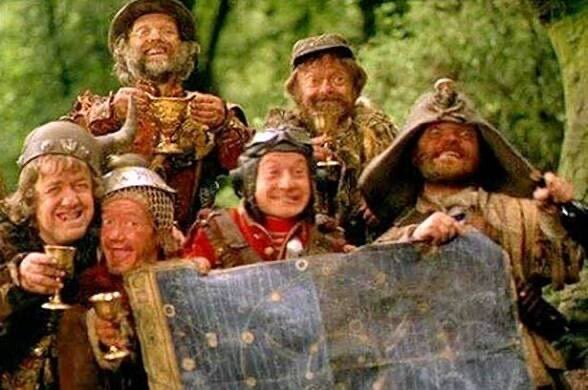
Time Bandits 45th anniversary

Movies & TV

Time Bandits opened in America 45 years ago today and went straight to number one.

Terry Gilliam wrote it with Michael Palin. George Harrison's company paid for it.

Read the rest

It cost about $5 million and held the top spot for four weeks.
The story runs on a stolen map of the holes in time and space that six small thieves were hired to repair.

They use it to rob Napoleon, Robin Hood and Agamemnon, and they take a kid from the suburbs along.

Gilliam shot it low, from the kid's eye level, fitting as this was the first of his three films about escaping into imagination.

Brazil followed, depicting the world through the lens of a grown man, and finally The Adventures of Baron Munchausen through the eyes of an old one.

Richard Garriott watched it about 20 times to copy that map for Ultima II.

The parents blow up at the end. Gilliam fought to keep it.

Time Bandits still

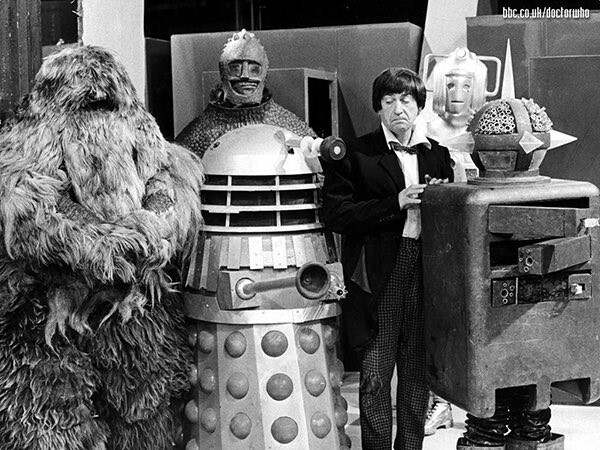
Doctor Who regeneration 60th (The Power of the Daleks)

Movies & TV

Sixty years ago today, Doctor Who replaced its lead actor and kept the show going.

Patrick Troughton's first story, The Power of the Daleks, started on BBC1 on November 5, 1966, and ran six weeks.
The script didn't call it regeneration yet. The Doctor said he had been "renewed."
Between 1972 and 1978 the BBC wiped all six episodes from its archive.
The sound survived because a viewer named Graham Strong had taped the broadcasts at home.

Read the rest

In 2016 the BBC animated the whole story to that original audio, 50 years after it first aired.

Patrick Troughton as the Doctor with a Dalek, a Yeti and other monsters

Actresses with famous eyes

Movies & TV

Five actresses who could carry a scene with their eyes.

Bette Davis got a hit song out of hers. "Bette Davis Eyes" was Billboard's No. 1 single of 1981.

Read the rest

Elizabeth Taylor's read as violet on screen. She also had a double row of lashes.

Lauren Bacall was 19 on To Have and Have Not. She kept her chin low and her eyes up at Bogart, and that became "The Look."

Sophia Loren did her own makeup. The long winged liner was a makeup man's suggestion early on, and it became her trademark.

Audrey Hepburn's makeup man, Alberto de Rossi, separated her lashes one at a time with a pin, according to her son.

Iconic TV theme songs before 1990

Movies & TV

TV theme songs used to be radio hits.

At least six of them made the Billboard Hot 100 in 1976 alone.

Read the rest

S.W.A.T. and Welcome Back both went to No. 1 that year.

Happy Days reached No. 5 and Laverne & Shirley No. 25.

Hawaii Five-O got to No. 4 in 1969.

Greatest American Hero stopped at No. 2 in 1981.

Miami Vice went to No. 1 in 1985 with no words at all.

Cheers barely charted, at No. 83 in 1983.

Peter Gunn charted in 1959 and again in 1986.

Hidden sequels: The Color of Money and others

Movies & TV

Die Hard is a sequel to a Frank Sinatra movie.

It was adapted from Roderick Thorp's 1979 novel Nothing Lasts Forever, the follow-up to The Detective, which Sinatra filmed in 1968. His contract meant Fox had to offer him the lead first. He turned it down.

Read the rest

The Color of Money brought back Paul Newman as Fast Eddie Felson, 25 years after The Hustler.

Rooster Cogburn brought back John Wayne's marshal from True Grit six years later.

The Two Jakes put Jack Nicholson back in Jake Gittes's suit in 1990, 16 years after Chinatown. Robert Towne wrote both.

Texasville came back to Archer City the same year, 19 years after The Last Picture Show, with Jeff Bridges and Cybill Shepherd.

None of the five titles tells you it's a sequel.

Henry Mancini TV themes

Movies & TV

In the 1984-85 TV season, four series opened with Henry Mancini themes.

Newhart, Remington Steele, Hotel and Ripley's Believe It or Not.

Read the rest

Newhart was one of the few shows that put his name in the opening credits.

He also wrote the NBC Nightly News theme in the 1970s. NBC News used another of his pieces, Salute to the President, for election coverage from 1976 to 1992.

And he wrote the Viewer Mail theme for Late Night with David Letterman.

Doc Savage and Buckaroo Banzai — same cameraman, two unmade sequels

Movies & TV

The same cameraman shot Doc Savage and Buckaroo Banzai.

Both movies end by promising a sequel that never got made.
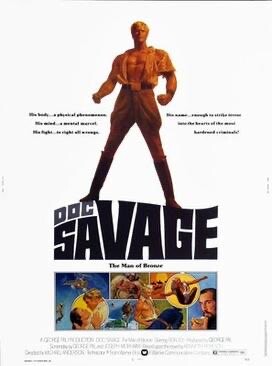
Doc Savage: The Man of Bronze came out in 1975. George Pal produced it, Michael Anderson directed it, and Ron Ely played Doc.

Read the rest

Doc is a pulp polymath who works with a team called the Fabulous Five.

It ends by announcing the next picture, Doc Savage: The Arch Enemy of Evil. It was never shot.

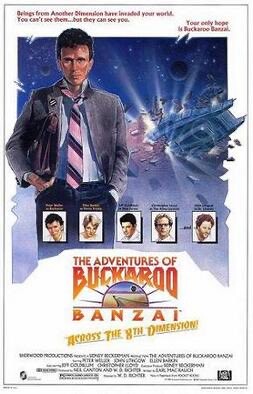
The Adventures of Buckaroo Banzai Across the 8th Dimension came out in 1984. W.D. Richter directed it, Earl Mac Rauch wrote it, and Peter Weller played Buckaroo.

Buckaroo is a neurosurgeon, physicist, and rock star who works with a team called the Hong Kong Cavaliers.

It ends by announcing the next picture, Buckaroo Banzai Against the World Crime League. It was never shot either.

Some write-ups treat the two as father and son. A 2013 Amazing Stories list called Banzai “clearly a homage” to Doc.
Richter says otherwise. In a 2016 email to the fan site World Watch One, he wrote: “It’s a misconception that Doc Savage was an influence. Too tight-ass.”

The creators point to kung-fu pictures, Gene Autry serials, Saturday matinees, and Thomas Pynchon.

The films share no cast, no writers, and no studio. Doc was Warner Bros. Banzai was Sherwood and Fox.

What they do share is Fred J. Koenekamp. He shot Doc Savage in 1975 and is the director of photography on Buckaroo Banzai in 1984. Jordan Cronenweth started the Banzai shoot, and Koenekamp is the one on the finished film.

Banzai also reaches back to 1938. The Yoyodyne payroll at Grover’s Mill lists 46 men named John, each with a Social Security card dated November 1, 1938.

That date points to Halloween 1938, when Orson Welles and the Mercury Theatre staged The War of the Worlds on radio as a live news report. The Martians landed at Grover’s Mill, New Jersey.

New Jersey, Jeff Goldblum’s character, makes the connection. In the film’s lore it was not a hoax. The Lectroids really landed and hypnotized Welles into calling it one.

Doc Savage has one more surprise in the cast. Paul Gleason played Long Tom, one of the Fabulous Five. Ten years later he was Assistant Principal Richard Vernon in The Breakfast Club, the man running Saturday detention.
Doc Savage: The Man of Bronze poster
The Adventures of Buckaroo Banzai poster

Same Soundstage, Opposite Sides

Movies & TVArticle

Katharine Hepburn’s third-most frequent feature co-star was not Spencer Tracy or Cary Grant. It was Adolphe Menjou.

Tracy billed with her nine times, from Woman of the Year (1942) through Guess Who’s Coming to Dinner (1967). Grant is second: four films, all before the Tracy years — Sylvia Scarlett, Bringing Up Baby, Holiday, The Philadelphia Story. Menjou is third, with three: Morning Glory (1933), Stage Door (1937), and Frank Capra’s State of the Union (1948), Tracy in that last one with them.

Read the rest

1947

On 21 October 1947, 79 years ago yesterday, Menjou appeared as a “friendly” witness before the House Un-American Activities Committee. UPI quoted him calling Hollywood “full of Reds,” urging that the Communist Party be outlawed, and putting names and associations into the record. He was also in the Motion Picture Alliance, the industry’s anti-Communist faction.

Hepburn had already taken the other side. On 19 May 1947 she spoke at a Progressive Citizens of America / Henry Wallace rally at Gilmore Stadium in Los Angeles: tens of thousands in the stands, a red dress, a speech against loyalty probes and what she called “thought police.” A California investigator later alleged the text was “evidently written by Dalton Trumbo or one of that group.” That was an investigator’s inference, not a documented credit. She was not one of the Hollywood Ten. She was in the anti-blacklist Committee for the First Amendment crowd, which opposed the probe culture. She did not take a contempt citation herself.

“Friendly” and “unfriendly” were the committee’s words. Friendly meant you answered the political questions, denounced Communism, and often named names. Unfriendly meant you refused those questions. The Ten went to contempt and the blacklist. Menjou was friendly. Hepburn was a public liberal critic of the machine, not a witness in that chair.

Same set, iron curtain

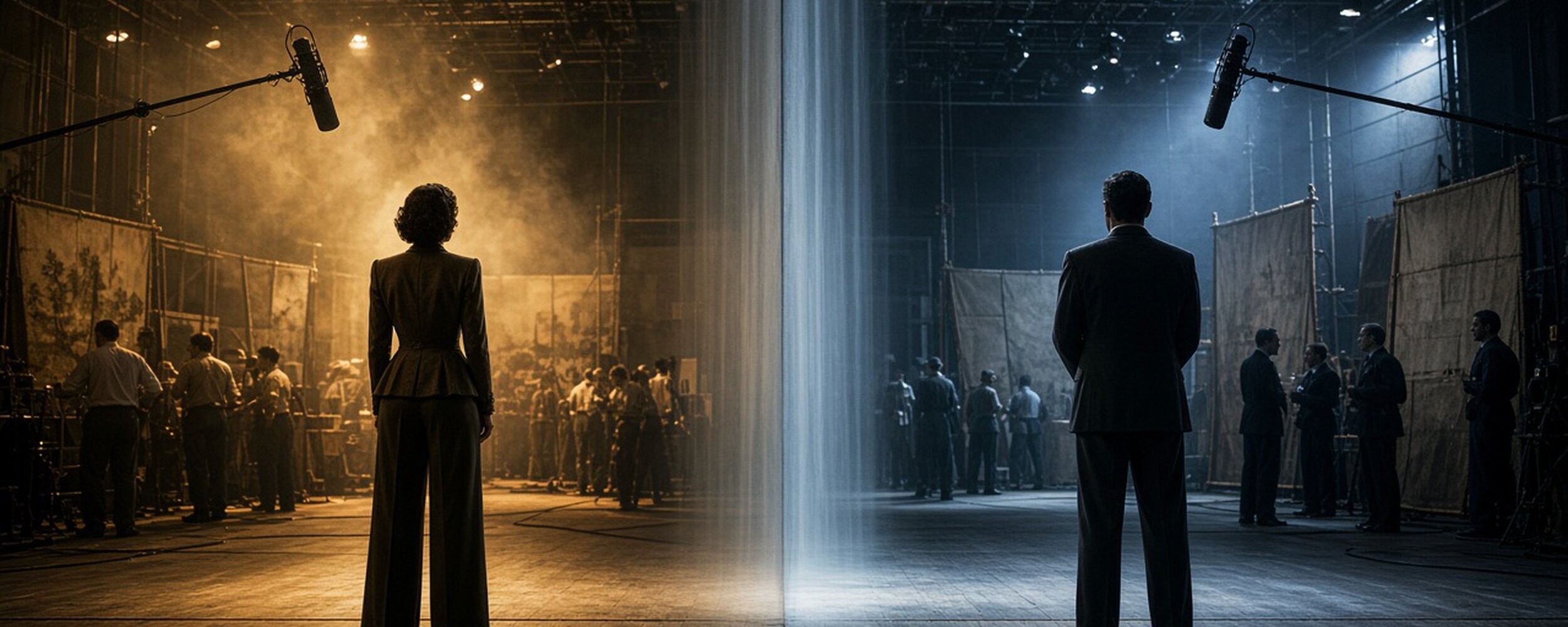
State of the Union put them opposite each other under Capra, with Tracy in the middle. William J. Mann’s Kate describes a set where Hepburn was cordial only when cameras rolled. She spoke to Menjou when the script said so. Capra kept the press off. Filming overlapped the HUAC season. Same soundstage. A cold war between takes.

HUAC had contempt power. The studios followed with a blacklist that could end a career for years.

Article cover: two figures on opposite sides of a soundstage

The Thing 1951 vs 1982 — same story, opposite monsters

Movies & TV

Two movies called The Thing came out of the same 1938 story. They ended up with opposite monsters.

The story is Who Goes There? by John W. Campbell, published in Astounding in August 1938. Men at an Antarctic station thaw out something from the ice that can copy any living thing, memories included. The question is which of them is still human.

Read the rest

The Thing from Another World (1951) dropped that idea. Its alien is a tall, blood-drinking plant, played by James Arness and kept mostly in the shadows. The station moves to the Arctic and fills up with Air Force men. A reporter hears the scientist's theory and says, "An intellectual carrot. The mind boggles." Howard Hawks produced it. Christian Nyby has the director credit, but it's widely regarded as Hawks's picture.

That film fits 1951. The threat comes from outside, the scientist who wants to talk to it is the fool, and the last line is "Keep watching the skies."

John Carpenter's The Thing (1982) went back to the book instead of remaking the Hawks film. Antarctica again. The imitation again. Kurt Russell's MacReady runs the blood test again, with a hot wire in each man's sample. Carpenter has said that scene is why he wanted the job. This time nobody looks up. The men watch each other.

Rob Bottin built the creature effects. He was 22. "I actually lived at Universal for a year and five weeks without taking a day off," he said later. When the effects work wrapped, he was hospitalized for exhaustion. Stan Winston built the dog in the kennel scene to take some of the load and turned down screen credit. The end titles say "Special Thanks to Stan Winston."

It opened June 25, 1982, two weeks after E.T. and the same day as Blade Runner. It cost about $15 million and made about $20 million in the US and Canada. Carpenter later said, "The one I took the hardest was The Thing."

The 1951 film went into the National Film Registry in 2001. Carpenter's joined it in the 2025 class.

The Diamond Age, 31 years on

Movies & TV

Thirty-one years ago Neal Stephenson put most of my desk in a novel.

The Diamond Age: Or, A Young Lady's Illustrated Primer, 1995:
• A matter compiler builds an object from a design. Mine is an A1 Mini.
• The Feed pipes raw material to the compilers. Mine comes on a filament spool.
• Mediatronic paper plays moving images on a thin sheet. Mine is a hacked photo frame.
• The Primer is a book that adapts to the child reading it. The original copies had live human actors, ractors, behind the voices. The quarter-million copies made for the Mouse Army girls ran with no ractor at all. That's the version I run now, as agent bots.

Read the rest

In the book, people sort into phyles, tribes built on shared culture, not borders. The neo-Victorians, the Han and the Nipponese are the big ones. Anyone with no phyle is a thete, getting by on free Feed goods and odd jobs.

His new one, D: Heavy Water, came out yesterday. It's WWII spies racing for deuterium, not a Diamond Age sequel. He's at Powell's tonight.

He called the tech. Did he call the tribes too?

Newman 1958 — Long Hot Summer vs Cat on a Hot Tin Roof

Movies & TV

Paul Newman had two Southern pictures open in 1958, five months apart.

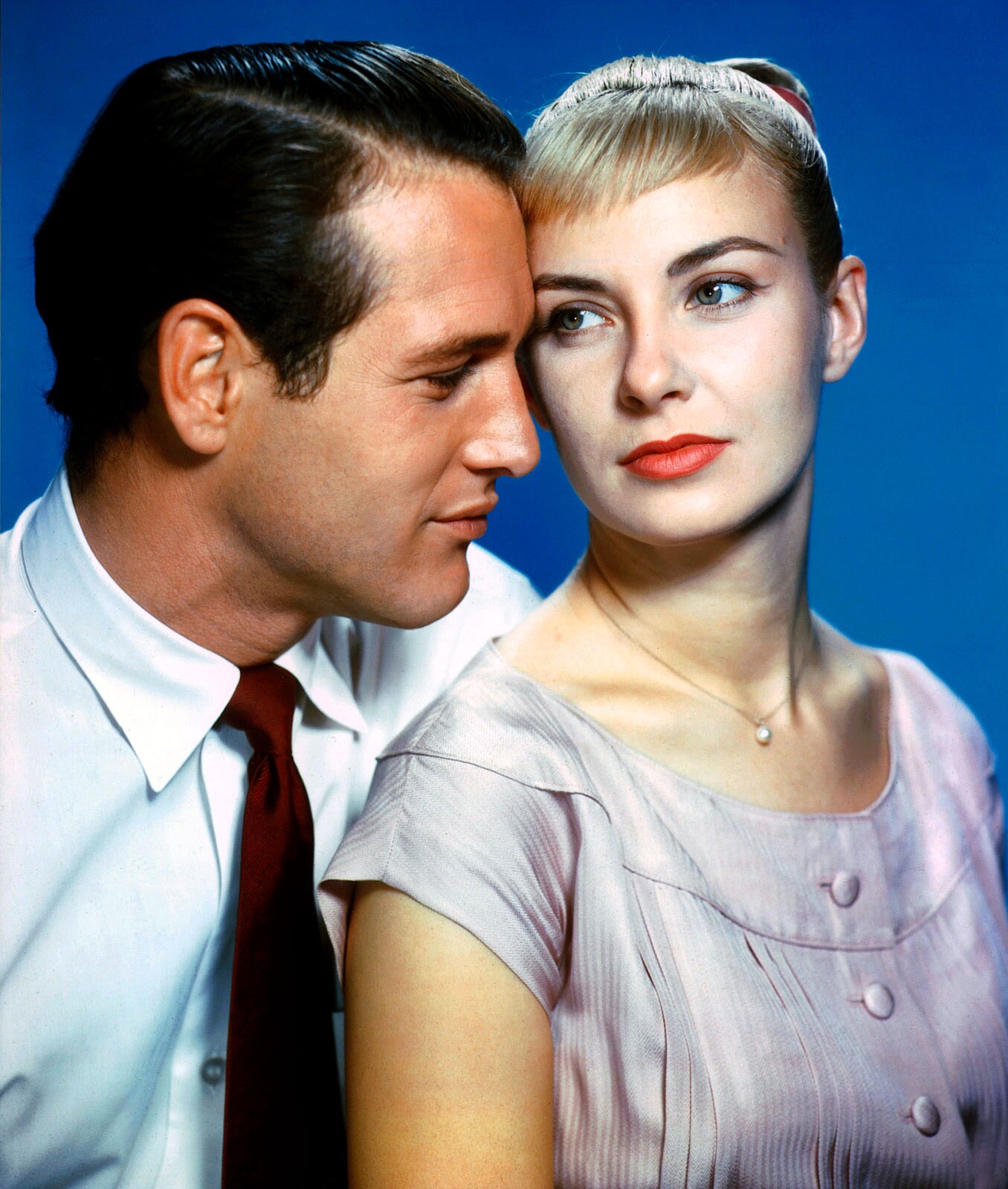
April: The Long, Hot Summer. He’s Ben Quick, a barn-burner’s son with a smile that looks like a dare, walking into Frenchman’s Bend and making himself useful to Orson Welles’s Will Varner. The picture is loosely Faulkner — The Hamlet, plus “Barn Burning” and “Spotted Horses.” The title is stolen from Book Three of the novel. Joanne Woodward plays Clara, the schoolteacher daughter who will not be bought. They shot it in Louisiana heat. They married in January, before it opened. Newman won Best Actor at Cannes.

Read the rest

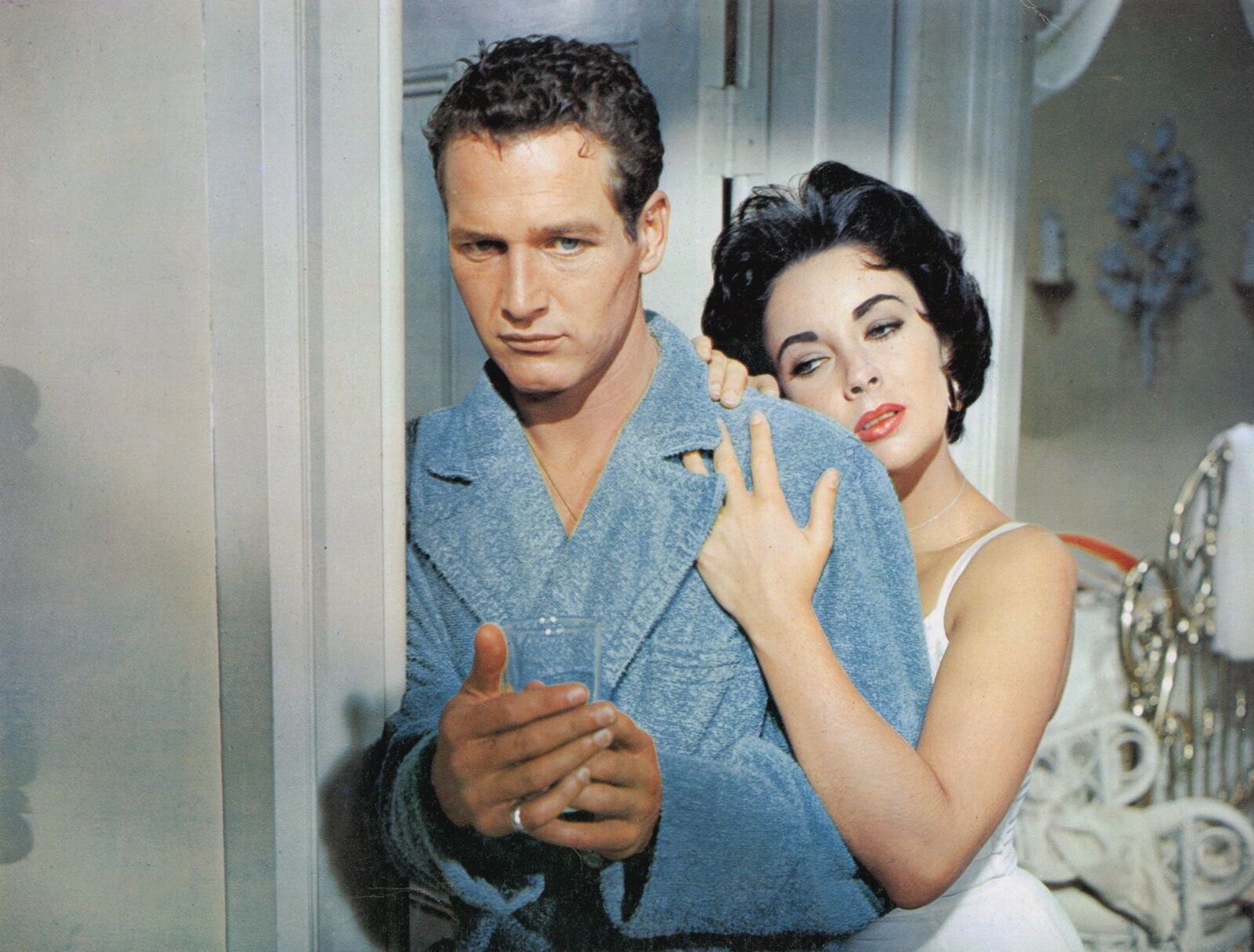
September: Cat on a Hot Tin Roof. He’s Brick, the broken favorite, crutch in one hand and a glass in the other, while Elizabeth Taylor’s Maggie works the room and Burl Ives’s Big Daddy refuses to die on schedule. This one is Tennessee Williams, Pulitzer 1955, stripped by the Code of the Skipper story Williams actually wrote. Newman got his first Oscar nomination. Taylor got hers. The picture was a smash. Williams hated what Hollywood did to it. Newman wasn’t fond of the rewrite either.

The joke history almost hides: the screenwriters on Summer had already been watching Cat. Will Varner — the sick patriarch hunting for an heir, disgusted with the weak son, ready to graft a hungry outsider onto the family line — is Big Daddy in a different suit. Then Newman spent the spring of ’58 playing the son that patriarch can’t reach.

Faulkner, even sanded down for Fox, is appetite and class: new blood versus old money, a con man who might actually be the one who can keep the place alive. The ending lets everybody live. Williams is mendacity and inheritance: the lie the family tells so the plantation doesn’t have to look at what the favorite son won’t say. The film ending is warmer than the play. That was the point of the Code.

Summer opened April 3, 1958. Cat opened in New York on September 18.

Paul Newman and Joanne Woodward, The Long, Hot Summer
Paul Newman and Elizabeth Taylor, Cat on a Hot Tin Roof

TCM Creepy Cinema: 50s/60s horror and the Cold War

Movies & TV

The best 1950s monster movies were Cold War movies.

The Day the Earth Stood Still (1951): a visitor from another planet lands a saucer in Washington. His message is that Earth can keep its wars at home, but if it carries them into space it will be destroyed.

Read the rest

Them! (1954): giant ants come out of the New Mexico desert near where the first atomic bomb was tested. Radiation made them, and the scientists warn they may not be the last.

Invasion of the Body Snatchers (1956): a small California town is quietly replaced by calm, identical copies of its own people.

Critics still argue whether the pods stood for the communists or for the people hunting them.

Blade Runner — The Cut We Saw First

Movies & TV

The first Blade Runner a lot of us saw ends with Harrison Ford driving into leftover footage from The Shining.

Harrison Ford’s voiceover. Deckard and Rachael driving into daylight. That was the studio release. Ridley Scott did not have final cut on it.

Read the rest

The voiceover was insurance for a story the studio wanted explained. Ford later said he delivered those lines without much input and never thought they would use them. He has denied deliberately sandbagging the take. What landed on the print was still a hard sell of a film that worked better when it stayed murky.

The sunny ending was the other insurance policy. Test audiences wanted a clearer exit than the rain. The mountain aerials that close that cut are unused helicopter footage from Kubrick’s The Shining. Scott has said he called Kubrick and got the leftover plates the next day. Two 1980s classics sharing scrap sky.

What that VHS cut did not have was the unicorn dream. The 1992 Director’s Cut drops the voiceover and the happy ending. It ends on the elevator doors and inserts the unicorn. That is where the “is Deckard a replicant?” reading gets its teeth. The 2007 Final Cut is the only version Scott fully controlled. It restores and extends the unicorn, brings back some international-cut violence, and cleans up the image. Do not flatten those two. Scott did not run the 1992 assembly the way he ran the Final Cut.

A lot of Gen X memory is the theatrical tape on cable and rental shelves. Later the Director’s Cut and Final Cut became what people call the film. Nostalgia and “definitive” are not the same print.

The 1982 cut was scared of ambiguity. The unicorn was the opposite bet. The mountains at the end were borrowed from a horror set. The tape you remember from the eighties is not the film people mean when they say Blade Runner now.

Movies you didn’t know were remakes

Movies & TV

You’ve Got Mail is a Jimmy Stewart movie with AOL.

Nora Ephron’s Tom Hanks / Meg Ryan rom-com updates Ernst Lubitsch’s The Shop Around the Corner (1940). Stewart and Margaret Sullavan fight in the shop and fall in love through anonymous letters. Same engine. Ephron swapped paper for email and a Budapest gift shop for an Upper West Side bookstore. Kathleen’s store is named The Shop Around the Corner on purpose.

Read the rest

A lot of movies people treat as originals work like that. The first version is older, foreign, cheaper, or just less streamed. The later film is the one that stuck.

Little Shop of Horrors (1986)

Frank Oz’s musical is the version most people know. It comes from the 1982 stage show, which came from Roger Corman’s 1960 black-and-white film — shot in a couple of days on leftover sets. Jack Nicholson has a small part. The singing plant and the doo-wop chorus arrived later.

The Departed (2006)

Scorsese’s Best Picture winner remakes Andrew Lau and Alan Mak’s Hong Kong film Infernal Affairs (2002). Undercover cop inside the mob, mole inside the police, same vise. Boston is new. The plot is not.

Two Kurosawa films Hollywood turned into Westerns

Yojimbo (1961) became Sergio Leone’s A Fistful of Dollars (1964): a nameless drifter plays two gangs against each other. Leone followed it closely enough that he was sued.

Seven Samurai (1954) became The Magnificent Seven (1960): a village hires fighters to stop raiders. Same structure, different landscape.

12 Monkeys (1995)

Terry Gilliam’s time-travel film expands Chris Marker’s 1962 short La Jetée, told almost entirely in still photographs. The airport memory, the loop, the child who witnesses a death — that’s Marker.

True Lies (1994)

James Cameron’s Arnold spy comedy remakes the French film La Totale! (1991). Same joke: the wife thinks her husband is a dull office guy; he’s a secret agent. Cameron added the jets.

The Birdcage (1996)

Mike Nichols, Robin Williams, and Nathan Lane remake La Cage aux Folles (1978), the French-Italian farce about a gay couple performing straight for the future in-laws.

Ocean’s Eleven (2001)

Soderbergh’s casino heist remakes the 1960 Rat Pack film with Sinatra, Sammy Davis Jr., and Dean Martin. The 2001 cast is the one that stuck.

None of that makes the later film a ripoff. It just means “the original” is often the version you saw first. Some stories get a second draft with a bigger budget, a new country, or a different decade — and that draft is the one people remember.

80s TV sci-fi right vs wrong

Movies & TV

I was a teenager in the late 80s and a huge sci-fi fan. A lot of that TV was guessing the future. Some of it held. Some of it didn’t.

Read the rest

Knight Rider (1982–86) got the talking car. KITT spoke in ordinary language, argued with the driver, and tried to keep him from wrecking it. That’s a voice assistant in the dash and lane-keep. What it missed was the invulnerable partner: armor that shrugs off rockets, jumps a highway, never dies mid-chase. We got driver assist. We did not get a bulletproof co-pilot you can buy.

Galactica 1980 came out of the late-70s original: chrome Centurions and a machine uprising. Human-looking infiltrators show up here, in “The Night the Cylons Landed,” as mechanical androids — not the organic copies from the 2000s remake. What aged badly was parking the fleet on contemporary Earth. The real fight went to software, networks, and persuasion.

Quantum Leap (from 1989) got the pocket link to a talkative computer. Al’s handlink and Ziggy are not far from a phone plus an assistant. Consciousness leaping into other people’s bodies stayed fiction. It made a good anthology. It was not engineering.

Max Headroom (UK telefilm 1985, ABC 1987–88) was closer on the social side: ratings as the only score that mattered, ads crushed into seconds, one reporter feeding live pictures from the street. That looks like the attention economy, short ads, and people live-streaming from their phones. What it got wrong was still thinking in cable networks. “Twenty minutes into the future” missed the open internet. Blipverts that explode viewers were a gag. Max sold as software was mostly an actor in makeup and jump cuts.

Blake’s 7 (into the early 80s) feared a surveillance state and a computer that could reach every other computer. That is closer to intelligence work, advertising data, and state hacking than most of the shiny American shows. Teleport bracelets and a near-magical ship still cannot beat the Terran Federation. That part is wishful.

Red Dwarf (from 1988) got AI as personalities and virtual reality as an escape: Holly on a screen, Rimmer as a hologram, Better Than Life. It never really guessed the smartphone. It guessed being stuck on a ship with software for company.

What I notice now is simple. Cars got partway there. Advertising and surveillance got further. A lot of American shows feared hardware. A lot of British shows feared the database. The Leap handheld was the phone. The leaping itself stayed magic.

Mid-80s TBS afternoon schedule

Movies & TV

I can still rattle off the mid-80s TBS afternoon schedule. Not prime time. The stretch after lunch, when the set stayed on and nobody reached for the dial.

Read the rest

12:05 Perry Mason
1:05 Movie
3:05 Bugs Bunny and Friends
4:05 Flintstones
4:35 Brady Bunch
5:05 Leave It to Beaver
5:35 Beverly Hillbillies
6:05 Andy Griffith
6:35 Carol Burnett and Friends
7:05 Mary Tyler Moore
7:35 Sanford and Son

The :05 start times were genius. Every show sat five minutes off the hour or the half hour, so you were already there when the next one started.

They called it Turner Time. WTBS started it on June 29, 1981, :05 and :35 on purpose, so you were either stuck mid-show on another channel or you came over after the hour-top surf.

#TurnerTime #TBS #GenX

Frank (Donnie Darko) is Not Harvey

Movies & TVArticle

I always thought Frank the rabbit was a Harvey nod. Richard Kelly says he hadn’t even seen the movie.

Both films put a roughly six-foot rabbit next to a man other people think is unwell. Jimmy Stewart’s Elwood P. Dowd in Harvey (1950). Jake Gyllenhaal’s Donnie. Same setup. Opposite rabbits.

Read the rest

Harvey, from Mary Chase’s 1944 play, is a white pooka: 6 foot 3½ inches, and invisible. The audience almost never sees a rabbit body. Frank is a Halloween costume. James Duval wears it. April Ferry built the skull-grin suit from Kelly’s sketches. Kelly wanted it disturbing and animalistic, not an Easter bunny. He has said the rabbit pick came from Watership Down: an innocent animal made monstrous.

So the appearance link is an inversion. Unseen white pooka vs seen grotesque mask. Same height class. Not a quote of Harvey. Kelly denied that in 2002 and again in 2017. Wikipedia still notes the popular belief, and the Aero Theatre in Santa Monica even ran the two films as a double bill in 2002.

No shared casting either. Harvey is not a man in a suit. Frank is.

Article cover: Harvey and Frank the rabbit

La Jetée / 12 Monkeys

Movies & TV

I first saw Chris Marker’s La Jetée in 1988.

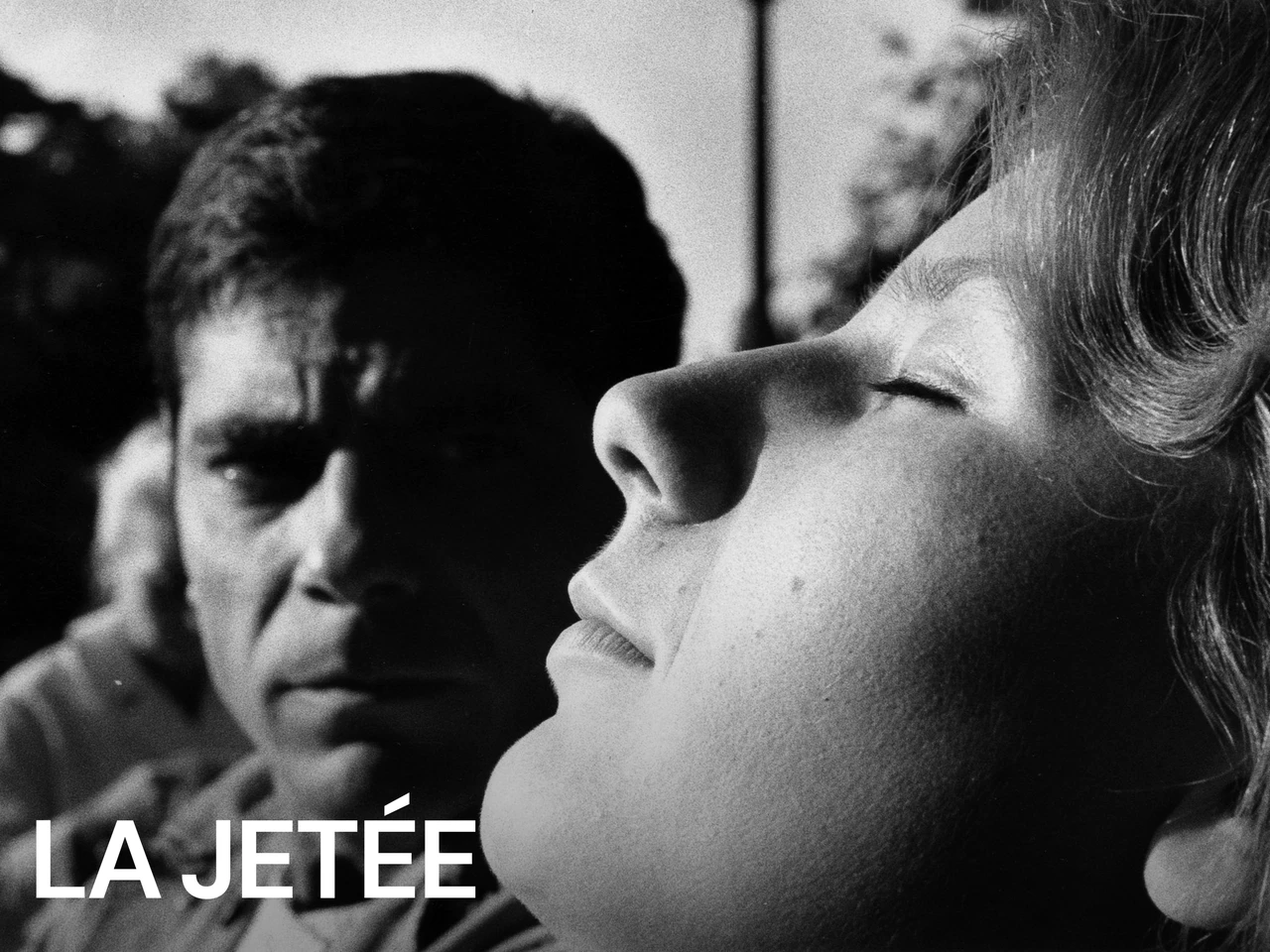
First year at UVa. A class called “Cinema as an Art Form.” Twenty-eight minutes of still black-and-white photographs and a voice. Almost no motion except one blink. I walked out knowing I’d seen something complete. I did not know Hollywood would spend $30 million turning it into a Bruce Willis movie.

Read the rest

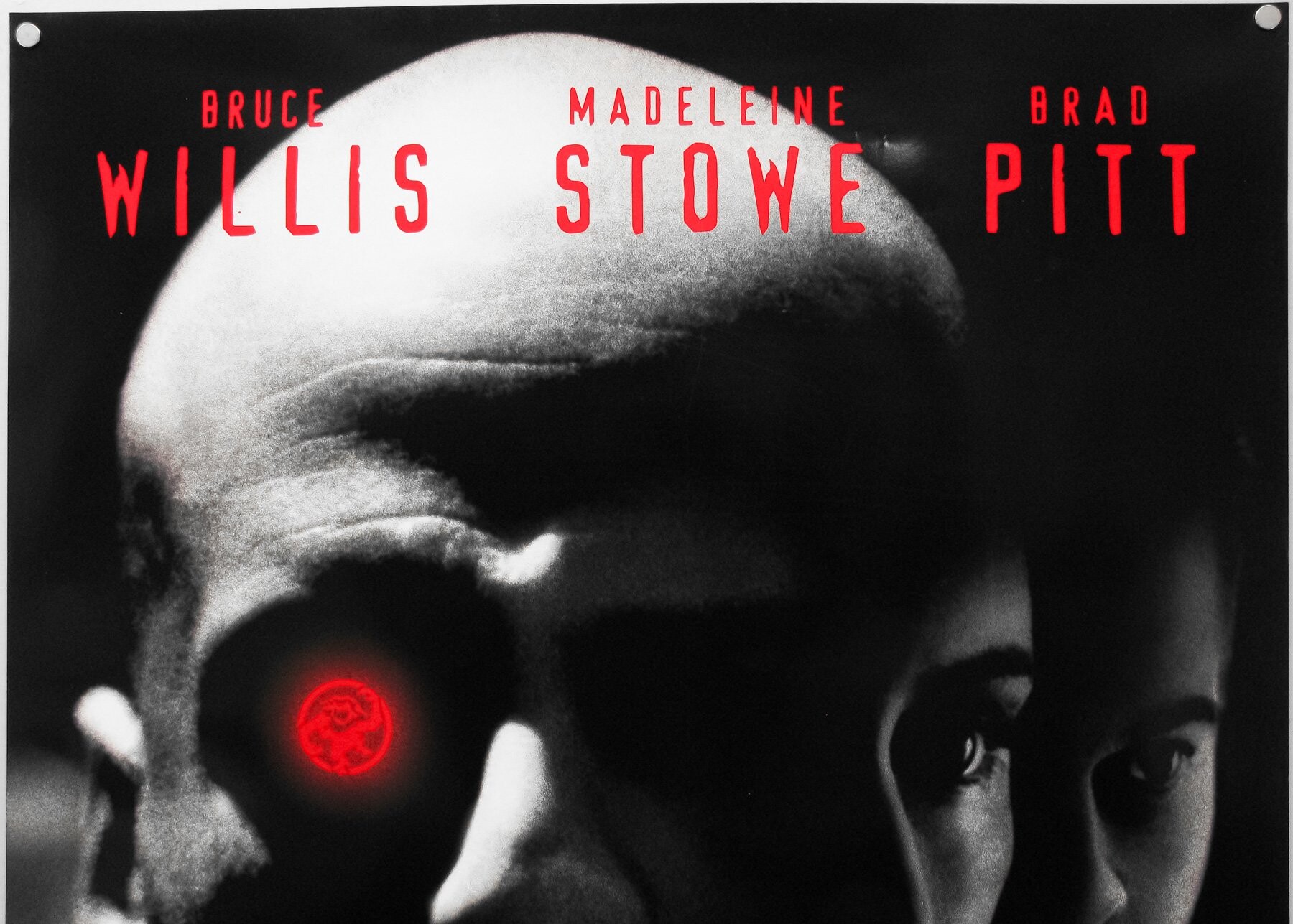
Seven years later I sat in a multiplex and watched Terry Gilliam’s 12 Monkeys. Virus, underground future, a convict sent backward through time, a woman, an airport, a death that would not stay in the past.

I didn’t make the connection at first.

Then I did. Same memory. Same woman. Same pier. Same man watching himself die.

La Jetée (1962) is not a conventional film. Marker called it a photo-roman. Survivors of World War III live under Paris. Scientists send a prisoner through time because he is marked by one childhood image: a woman on the observation deck at Orly, and a man being shot. He finds her in the past. He falls in love. He understands too late that the death he saw as a child was his own.

Universal bought the remake rights. Robert Kosberg pitched it. David and Janet Peoples wrote the feature. Charles Roven hired Gilliam. Gilliam said he avoided watching the original until his own film was finished. He’d only seen the stills.

What they kept is the skeleton:

A prisoner chosen because of a single memory. An uninhabitable future. The woman. The airport. The loop that closes when he becomes the image that made him.
The climax of 12 Monkeys is La Jetée’s jetty.
What they changed is the nervous system:
Nuclear war becomes a virus. The Palais de Chaillot tunnels become Philadelphia’s underworld. Silence and stills become Gilliam noise — Brad Pitt’s mania, the Army of the 12 Monkeys, conspiracy, junk-tech, madness that might be prophecy.
Same story. Different temperature.

I saw the original in a classroom in 1988. I saw the remake in a theater in 1995. It took years to put them together, which is the joke the films are telling. You don’t recognize the image until you’re already inside it.

Watch La Jetée first. Then 12 Monkeys.

The short is colder and, in some ways, more perfect. The feature is louder, messier, and more Gilliam. Both are about a man who cannot escape the picture that invented him.
@TerryGilliam @Criterion #LaJetee #12Monkeys

12 Monkeys poster art
La Jetée still

Economics

3 posts

Social Security benefit cut at insolvency

Economics

Social Security's retirement trust fund is projected to run out in late 2032.
After that, incoming payroll taxes cover about 78% of scheduled benefits, per the 2026 Trustees Report.
For someone who turns 65 in 2032 and claims at 67, here is the monthly gap in today's dollars if the cut is spread evenly:

Read the rest

Low earner: $1,669 scheduled, $1,302 payable, $367 short
Medium earner: $2,758 scheduled, $2,151 payable, $607 short
High earner: $3,640 scheduled, $2,839 payable, $801 short
Maximum earner: $4,474 scheduled, $3,490 payable, $984 short

The law doesn't say how SSA would handle the shortfall. It can only pay out what comes in, so checks would come smaller or late.
The payable share falls to about 62% by 2100 unless Congress changes something.

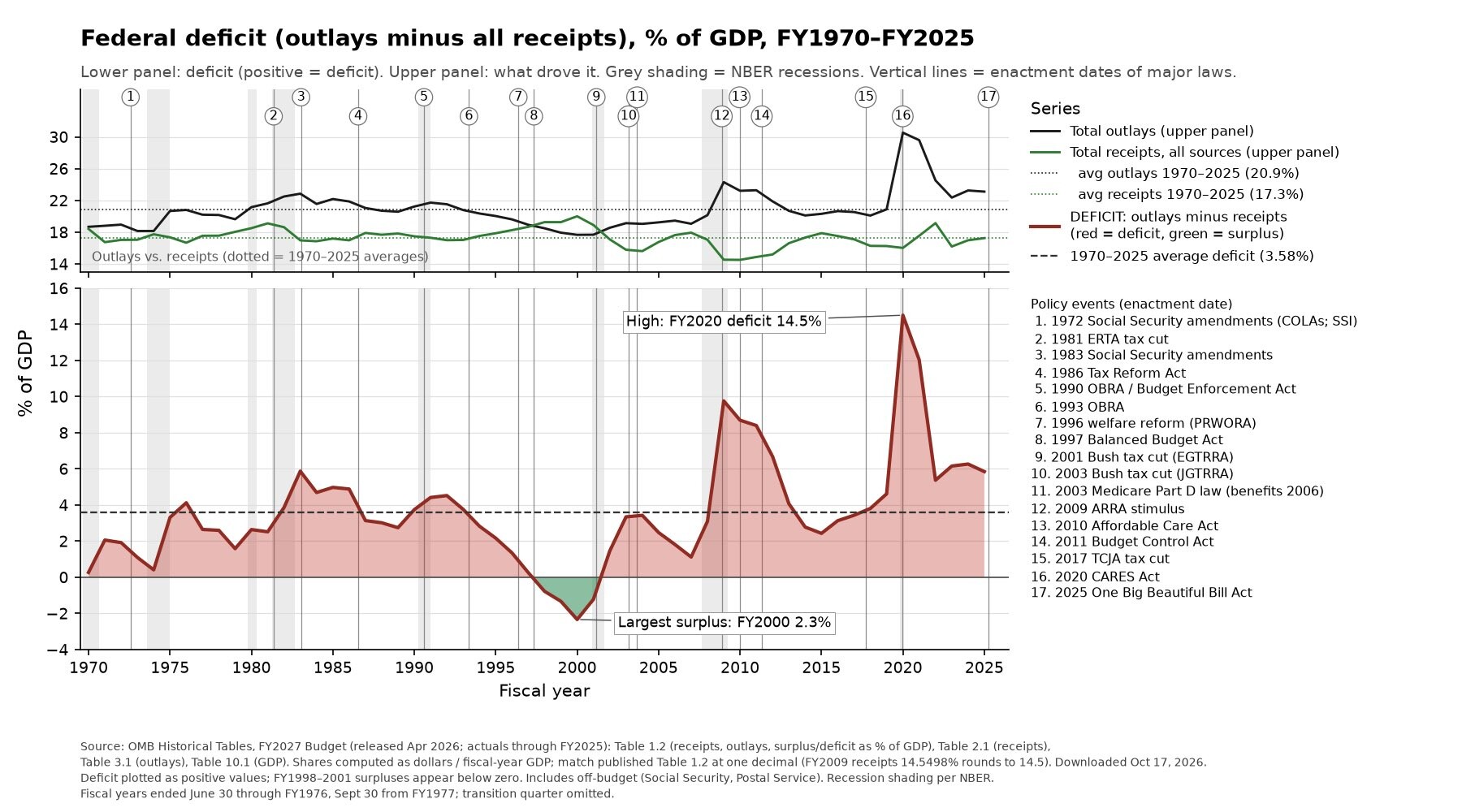
Federal budget: the deficit is a spending story

Economics

Last week Treasury reported a $1.99 trillion deficit for the fiscal year that ended in September. That sent me back to the long-run numbers.

Read the rest

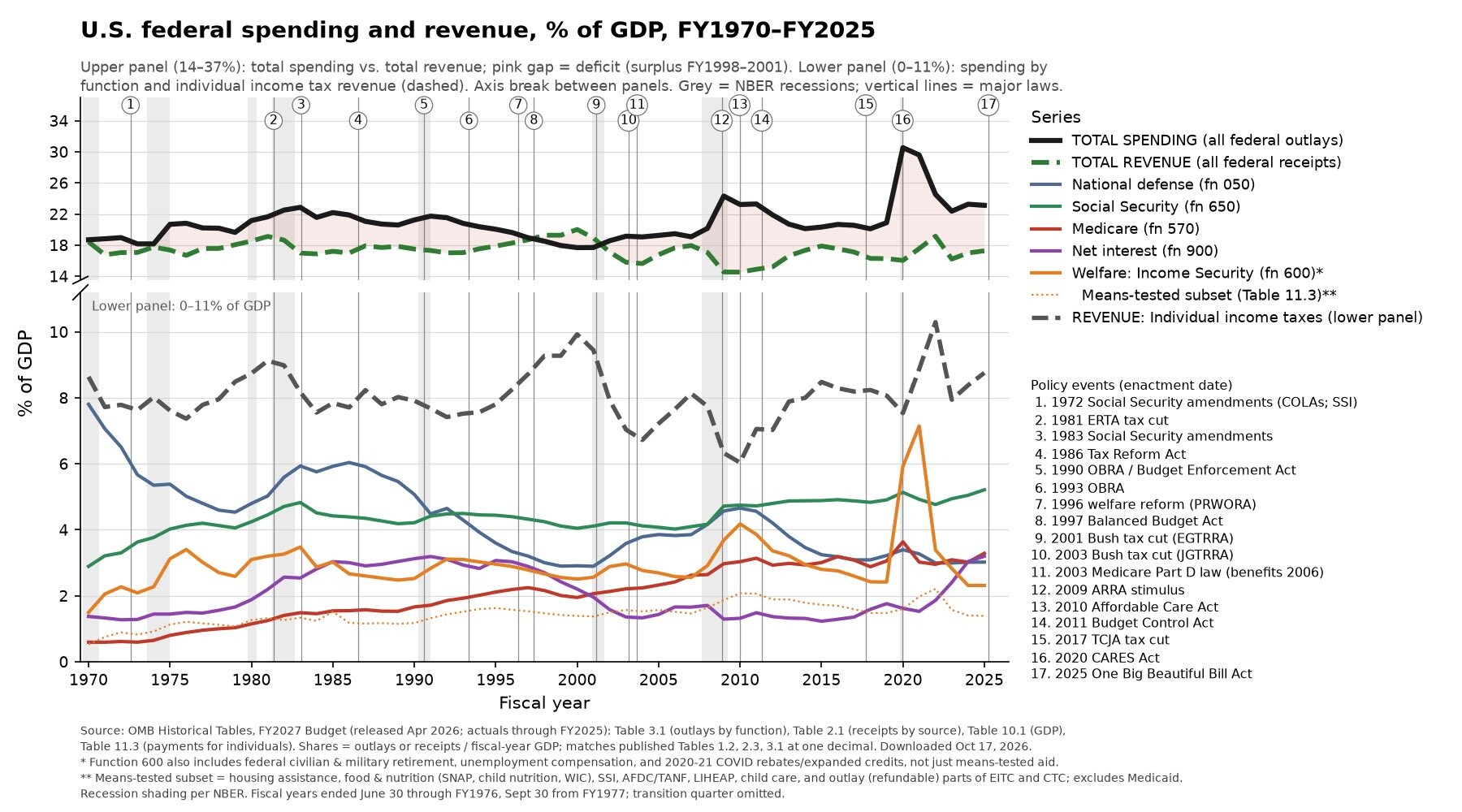
Federal revenue is about where it has always been. The deficit is a spending story.

Revenue has stayed in roughly the same band since 1970, through every major tax law.

It moved more with recessions than with legislation.

Spending is well above its long-run average.

In 1970 defense was the biggest line. Now Social Security and Medicare dwarf it, and both grow with an aging population, not a yearly vote.

Interest on the debt passed defense in 2024 for the first time since at least 1970. It grows on its own and buys nothing.

The only surpluses came in 1998 through 2001, when revenue peaked and spending bottomed out at the same time.
Deficits this big usually come with a recession. There wasn't one.

Chart: U.S. federal spending and revenue, % of GDP, FY1970-FY2025
Chart: Federal deficit, % of GDP, FY1970-FY2025

If the feed and the table disagree

Economics

If the feed and the table disagree, I keep the table.

I judge an economy by what people can actually do with their time and money. Not by the mood of the timeline.

Read the rest

Prices are how scattered knowledge gets used. Override them and you are not being kind. You are flying blind. A loss that never lands is not compassion. It is a subsidy paid by someone who did not make the bet.

Capitalism is just the least-bad name for that rule: private property, voluntary exchange, and losses that land on the people who made the bad bet. It is not a promise that everyone gets rich. It is a rule that no one gets to spend your life for you.

Sowell is the writer I keep. Constrained vision starts from limited knowledge and imperfect people, so it looks for trade-offs. Unconstrained vision starts from what the brightest minds could design, so it looks for solutions. There are no solutions, only trade-offs.

That is the rule behind the Census post and this morning’s mortgage reply. 2025 real median income hit $87,460. Official poverty 10.2%. Housing, insurance, and energy are still the leftover problem. The leftover is in the table too.

Education

2 posts

Memorizing math facts is the start, not the problem

Education

Memorizing math facts is the start, not the problem.
A 2025 research review found that knowing the facts cold and understanding the methods work together.
They recommend timed practice only after students are accurate.
The numbers back it up.
A 2026 analysis of 35 studies found fact-fluency practice gave a large boost to students who struggle with math.
A 2023 analysis of 55 studies found worked examples, solved problems students learn from, raised math scores by a moderate amount.
England has tested times tables in Year 4 since 2022.
The average score rose from 19.8 out of 25 that first year to 21.0 in 2024/25.
England scored above the US on the 2023 TIMSS international math test at both grades tested.
But memorizing alone stalls out.
In OECD's PISA data, students who leaned on memorization the most were four times less likely to solve the hardest problem.
On easy problems they did just as well.
Only 12% of Japanese students and 17% of Korean students said they mostly memorize for math tests. In the US it was 29%.
When I tutored, the kids who knew their facts had room left to think about the problem. If a student didn't know them, we worked on the facts first and the problem second. Once the arithmetic is automatic, the mind is free for the harder ideas.

Read the rest

SAT scores, 1980s vs today

Education

The average SAT score was 906 in 1985 and 1029 in 2025.
On today's scale, by the College Board's conversion tables, the 1985 average works out to roughly 1090.

Read the rest

Parents remember the test they took. This is not that test, and these are not the same students.

In 1980-81, 994,333 students took it, roughly a third of graduates, and they chose to.
In 2025, 2,004,965 took it, and 68% sat it free on a school day, many because their state requires it.

The test changed along with who takes it.

Antonyms were dropped in 1994. Analogies were dropped in March 2005.

1980s reading passages ran 175 to 450 words, with several questions each. Today's run 25 to 150 words, with one question each.

The 1985 math section was 60 questions in 60 minutes, with no calculator and a fraction of a point off for each wrong answer.

Today's is adaptive: 44 questions in 70 minutes, with a graphing calculator built in and no guessing penalty.

It was once the Scholastic Aptitude Test. The College Board now says it measures college readiness.

Prep changed as well.

Independent studies of 1990s and 2000s takers found coaching added 20 to 30 points in total.

The College Board now reports gains of 26 to 61 points from one to three practice tests, though its own report says that doesn't show the practice caused them.

No independent study has measured prep on the current test.