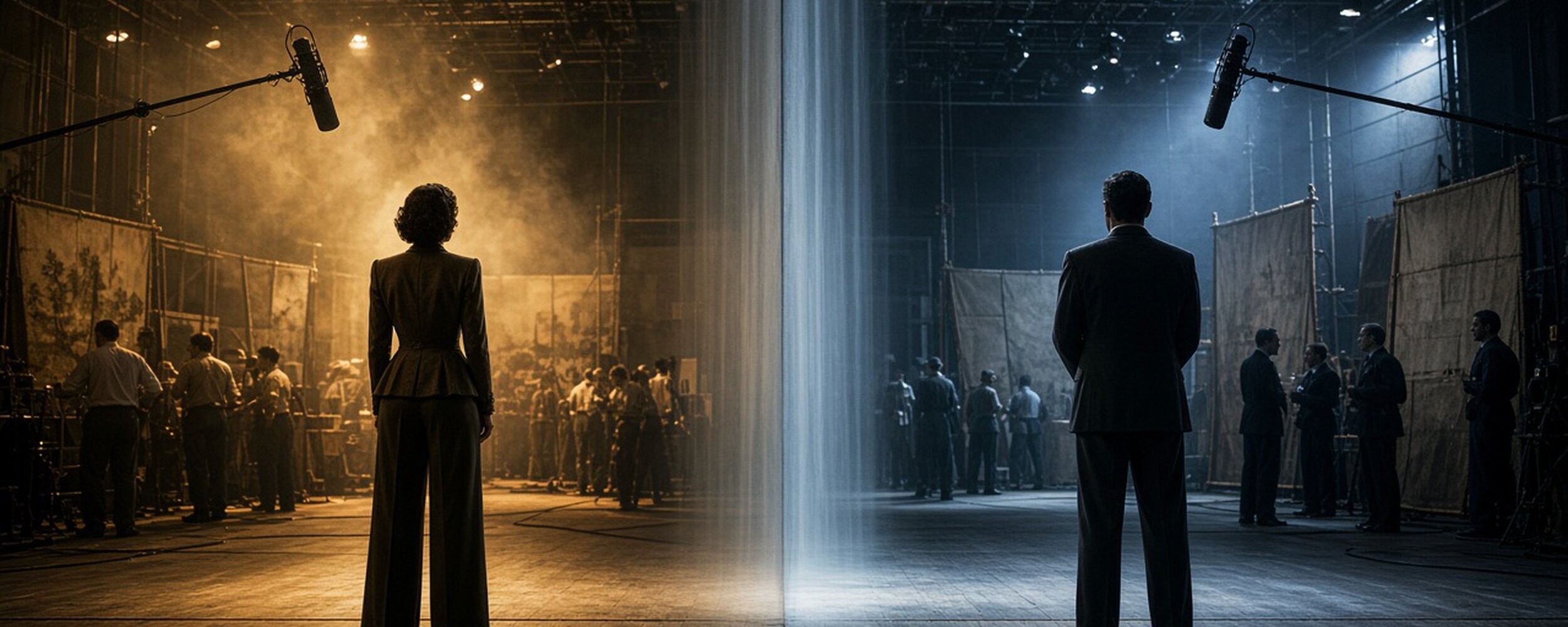
Same Soundstage, Opposite Sides
Katharine Hepburn’s third-most frequent feature co-star was not Spencer Tracy or Cary Grant. It was Adolphe Menjou.
Tracy billed with her nine times, from Woman of the Year (1942) through Guess Who’s Coming to Dinner (1967). Grant is second: four films, all before the Tracy years — Sylvia Scarlett, Bringing Up Baby, Holiday, The Philadelphia Story. Menjou is third, with three: Morning Glory (1933), Stage Door (1937), and Frank Capra’s State of the Union (1948), Tracy in that last one with them.
1947
On 21 October 1947, 79 years ago yesterday, Menjou appeared as a “friendly” witness before the House Un-American Activities Committee. UPI quoted him calling Hollywood “full of Reds,” urging that the Communist Party be outlawed, and putting names and associations into the record. He was also in the Motion Picture Alliance, the industry’s anti-Communist faction.
Hepburn had already taken the other side. On 19 May 1947 she spoke at a Progressive Citizens of America / Henry Wallace rally at Gilmore Stadium in Los Angeles: tens of thousands in the stands, a red dress, a speech against loyalty probes and what she called “thought police.” A California investigator later alleged the text was “evidently written by Dalton Trumbo or one of that group.” That was an investigator’s inference, not a documented credit. She was not one of the Hollywood Ten. She was in the anti-blacklist Committee for the First Amendment crowd, which opposed the probe culture. She did not take a contempt citation herself.
“Friendly” and “unfriendly” were the committee’s words. Friendly meant you answered the political questions, denounced Communism, and often named names. Unfriendly meant you refused those questions. The Ten went to contempt and the blacklist. Menjou was friendly. Hepburn was a public liberal critic of the machine, not a witness in that chair.
Same set, iron curtain
State of the Union put them opposite each other under Capra, with Tracy in the middle. William J. Mann’s Kate describes a set where Hepburn was cordial only when cameras rolled. She spoke to Menjou when the script said so. Capra kept the press off. Filming overlapped the HUAC season. Same soundstage. A cold war between takes.
HUAC had contempt power. The studios followed with a blacklist that could end a career for years.